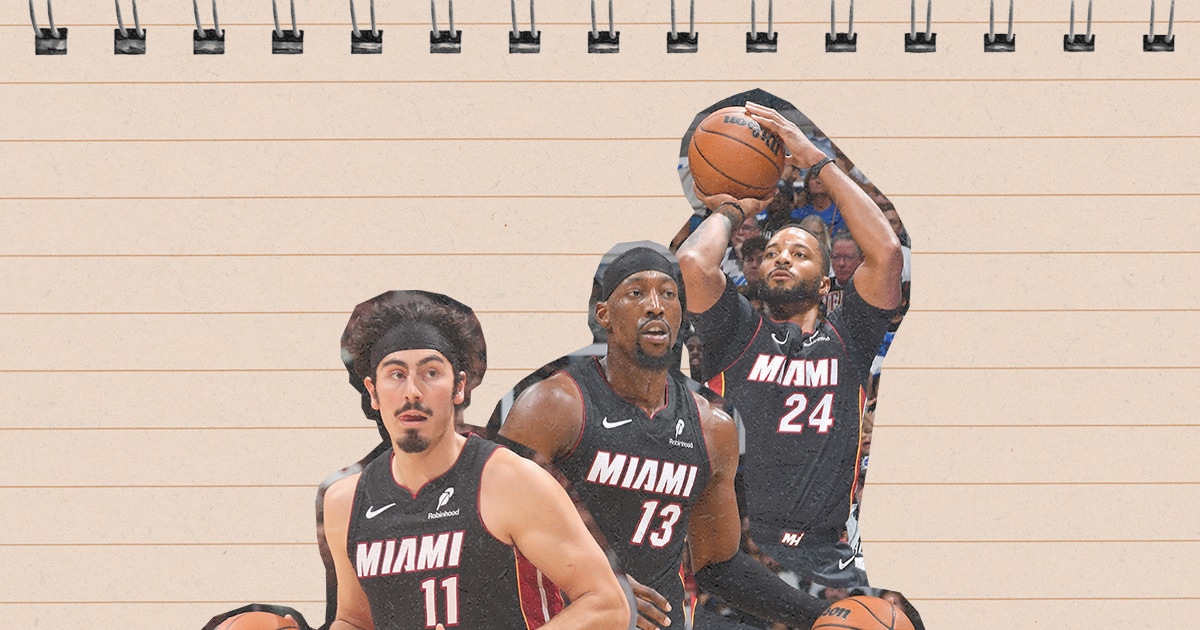
The Miami HEAT are 2-1 with an Offensive Rating of 115.8, Defensive Rating of 105.5 and Net Rating of +10.3, No. 3 in the NBA. Here’s what we’ve been noting and noticing about the first week of the season.
IT’S A DIFFERENT OFFENSE…IS AN UNDERSTATEMENT
Preseason numbers are always one thing. Sometimes they lie, sometimes they don’t. The regular season tells you the truth.
Under normal circumstances, we would wait a couple weeks for numbers and the schedule to normalize to start leaning one way or another on what is or isn’t sustainable. And as far as Miami’s efficiency numbers, that remains true.
But even though the HEAT have only played three games, we’ve already seen more than enough to tell you that the changes Erik Spoelstra has made to the offense are real, and they’re spectacular – from a certain point of view.
What we aren’t saying is that Miami is the best offense in the league. We haven’t even seen enough to say they’ll be a Top 10 offense, or that we even know for sure how much more effective this will all be compared to the last few seasons. That much, we need time for.
What this is is different. So different that anyone familiar with the HEAT’s typical offensive stylings is probably dealing with a little whiplash from all the double takes they’re doing making sure that they’re watching the right team. It’s fast, no doubt. Miami is leading the league in pace at 109.6 possessions per game, and though that number is likely inflated a little by a high steal rate but you don’t increase your pace by double-digit possessions with a couple more steals per game. They’re getting the ball over halfcourt quicker, shooting earlier in the shot clock and the pace is sustaining through all four quarters.
That speed will get much of the attention as it’s the biggest, most in your face adjustment. That’s natural when a team goes from No. 26 to No. 1 in transition opportunities (so far). The story with the longer tail as far as evolving throughout the season will be how Miami is running their offense.
Read-and-react is one thing. The HEAT have always had a read-and-react element to their offense. It’s one thing to have read-and-react elements, though, and another to have nearly the entire offense be based on that concept, on instinctual, moment-to-moment decisions. Of course it’s not actually the entire offense, but as close as the HEAT, and probably most other teams, have come. That’s how you end up with games like the win over New York where, as Bam Adebayo put it, “I don’t think we ran a play today”.
Consider, for instance, that Miami is only running 22 pick-and-rolls per 100 possessions through three games. Entering this season, the lowest mark of the past 13 years – as far back as we have player-tracking data – was the 2018-19 Philadelphia 76ers at 39.3. For the most part, with a nod to dribble handoffs which Miami has also largely put to the side, this has been a pick-and-roll league. Without that bread-and-butter staple, there is an adjustment process.
“At first it’s definitely weird,” Dru Smith said. “You just get in such a rhythm of doing that that early on, especially in camp, where you get stuck and you’re looking at each other like, ‘What do we do now?’”
They’ve all seemingly caught on rather quickly for such a drastic change, a sign that there was no time wasted in training camp and preseason. Even as the team lost all of its preseason games, there were signs that the process behind the touch-and-go results was healthy and developing. It helps when you have players like Norm Powell, one of the best catch-and-choose players in the league, his quick decisions knifing through defenses, or getting defenders on their heels and into foul-prone positions, or someone like Bam Adebayo, for years a major component of Miami’s pick-and-roll and handoff game, showing early willingness to changing from what has benefitted him in the past.
“We’re all bought into the system,” Adebayo said. “You see it. You don’t know who is going to shoot the ball or who is going to catch-and-go. That’s how we like it, that’s how we want to play. We want all five guys to be involved.”
When it looks good, it’s a beautiful thing to watch regardless of whether or not the open look goes in.
It is, of course, early. This is all such a departure from not only how the HEAT have operated, but from how most teams operate, that we have likely barely begun to see how teams will adjust once they have time to go through film and adjust. Tyler Herro, the highest-usage pick-and-roll player on the team, will be incorporated. The Knicks and Magic, both teams with bigger wings that can stop the dribble-drive attacks and, essentially, well-spaced isolations, were able to jam up Miami’s flow a bit. Teams were able to get more organized in transition and muck up all those clean hit-aheads the fast-break game has thrived on so far. It all looked mostly how it was supposed to look when New York made things difficult, and Miami will get better, too, but this is something that needs to work in April and May as much as it works in October. You can’t always play fast, but you can strive for quickness.
“Sometimes you’re not going to have an absolute flow in the last eight seconds, that’s not necessarily realistic,” Spoelstra said. “But your spacing better be dialed in and your decisions on the catch have to be precise. You can’t miss moments, particularly at the end of possessions.”
What this most definitely is, however, is fun. That much is undeniable. And for as much as we talk in wins and losses, in efficiencies and low-hanging fruit and optimization, fun most definitely matters.
JAIME RUNNING POINT
It’s been a nice start to the season after a nice preseason for Jaquez Jr. as he’s shooting over 70 percent from the floor with the vast majority of his shots coming within 10 feet of the rim. Since he entered the league the paint has been Jaquez Jr.’s best friend and so far he’s finishing his non-rim attempts more like his rookie season than last year (his rim efficiency was nearly identical in his first two years).
Spoelstra is deploying Jaquez Jr. differently, too. Even when he’s ostensibly playing the three or four spots depending on Miami’s lineup configurations, Jaquez Jr. is often playing the nominal point guard, bringing the ball up around 21 times per game. Davion Mitchell, actually starting at point guard, is bringing it up 29 times per game. Bam Adebayo, Andrew Wiggins, Norm Powell and Andrew Wiggins combine to move the ball across halfcourt about 18 times per game. Nikola Jovic does so around nine times. Last year Tyler Herro brought the ball up 22 times a night.
In other words, outside of the team’s actual starting point guard nobody is bringing the ball up more often than Jaquez Jr. and it’s not particularly close.
“Anything that gets him downhill and gets him aggressive fits him,” Spoelstra said. We just had to really clean up the spacing and the decision making to simplify things for him. Now, just let him loose.”
As a result, Jaquez Jr. is throwing a career-high 63 passes per 100 possessions, but what he isn’t doing is run much in the way of traditional offense, which makes sense because as noted above Miami isn’t running much traditional offense as a team. It isn’t bring the ball up and immediately get into a pick-and-roll, it’s push the ball up, look for a quick-hit attack route or a cross-matched defender Jaquez Jr. can go at – his isolations have nearly doubled year-over-year – and if it isn’t there then get off the ball.
“My No. 1 read is always the throw-behind guy,” Jaquez Jr. said. “Get into the paint, turn around, there should always be someone there as my outlet. That’s the simplest read. You got the dribble through for the corner. What we’re trying to get more of, what I’m trying to tell the guys, is to cut. Once I get onto that block, that fill behind guy but we also need that cut as well. We’re still working on getting that guy going. We’re still working on some of those reads but read No. 1 is attack the basket.”
The jumper volume is on the very low end at the moment. We’ll see if that changes, or even if it has to change. For the moment, putting the ball in the hands of a player who has been given a cushion at the arc counteracts that coverage through the earlier stages of possessions. And with Miami’s possessions as short as ever, there isn’t as much time for defenses to muck up the spacing. How that will change when Herro returns and the ball is distributed differently, we’ll see when we get there – especially if Mitchell is then coming off the bench. For the time being, Jaquez Jr. has found a role with some traction, one that has him as an NBA best plus-60 when on the floor, which is already an upgrade from his sophomore year.
TIDBITS
-Even though the Knicks put up 54 threes, shooting 27.8 percent, Miami had the better Shot Quality in that game with an expected effective field-goal percentage of 54.5 to New York’s 52.7. That said, Spoelstra noted he doesn’t necessarily want to be giving up that many deep attempts.
“They had some open ones that they missed,” Spoelstra said. “Especially some of those after offensive rebounds, some of the pick-and-flares. It is a different league, I would like to not have a habit of giving up 50 every single night, just the law of averages. It’s more about being up and into them and being there on the catch, forcing some other decisions with multiple efforts.”
-A part of Miami’s offense that is worth keeping a close eye on is that their isolations have spiked to 28.6 per 100 possessions so far. They’re different isolations than the more deliberate, matchup-hunting variety that we’ve seen in the past, more quick-hitter attacks with the strong side of the floor cleared out, but they are isolations nevertheless. A dribble-drive offense relies, inherently, on players being able to drive past their defenders with the dribble, though the timing and movement of the offense is of course operating to help those attempts start with an advantage against.
-Rebounding has been brought up often by Spoelstra often over the past month, and through three games is defensive rebounding at a rate that would have been Top 10 last year.