

Becoming a feared scorer at the NBA level requires you to be maniacal. There’s just no way around it. Your daily habits, mindset, and dedication have to be extreme.
Dillon Brooks understood the assignment early in his career.
In the years leading up to him joining the Suns, Brooks used to study multiple videos of Kobe’s mid-range craft and maneuvers while riding the exercise bike after practice. The first 30-minute video would be strictly one-dribble pull up jumpers, and the next video was dedicated to post-ups.
No detail was too small for him to take notes on. The footwork. The upper-body movements. The subtle bumps to create separation.
Learning how to score over defenders of any size was important to him. And it’s that consistent grind that’s paved the way for a career season in Phoenix.
This is undoubtedly the best version of Brooks, who became The Villian in Memphis known for his defensive tenacity and then, while spending two years in Houston, evolved into an impressive shooter and mentor everyone appreciated.
Brooks is averaging a career-high 21.2 points, nearly eight more than last season. He’s one of 41 players scoring at least 20 per game. But among that group, he’s also one of the most adept at taking care of the ball. With a turnover rate of just 9.6%, he ranks 9th out of those high-volume scorers.
As a defender, the impact is still profound. Brooks' stop percentage this season (steals + blocks + offensive fouls drawn per 100 possessions) is in the 70th percentile among all players and it’s his personal highest since the 2022 campaign. That’s when he helped the Grizzlies become a No. 2 seed in the West with one of the most potent defenses.
In a league that puts such a premium on positional versatility, Brooks’ ability to guard up or down – defending point guards on one possession and bigger power forwards the next – has given the coaching staff different solutions. He’s played a massive role in Phoenix moving up from 30th in halfcourt defense last season to sixth this year.

The beauty of this Phoenix Suns season is that everyone has played their part in turning the tide. If you had a pie chart of who was responsible for the 22-15 start, there would be plenty of slices to go around.
However, it can’t be ignored how Brooks has helped carry out Mat Ishbia’s vision from last offseason. In sports, being a culture-setter or laying the foundation for a new identity can be difficult to quantify. It’s hard to measure the impact of any individual player who walks into a new environment, or a team locker room, and changes their approach.
As silly as it sounds, it’s truly one those things you just feel by walking into the building and seeing the intensity. All it takes is hearing Brooks' teammates talk about the seriousness of each practice, listening to how he holds everyone accountable, and observing the daily habits.
This is the same guy who dapped up a teammate for accidentally elbowing him in the face in training camp, leaving him with a cut that resulted in six stitches above the eye.
Nobody sets a stronger tone and demands more of his peers than Brooks, who refuses to settle for average results in any activity, no matter the stakes or significance.
“I’ve been around some guys that only bring it out during games,” Suns head coach Jordan Ott said. “But he brings it out every day in practice, and I think he’s dragged a couple people with him. Some guys that I probably wouldn’t assume practice that intense every single day. He raises everyone’s level.”
His influence is felt throughout the roster, not just Phoenix’s backcourt. Oso Ighodaro plays a completely different style than Brooks as a low-usage, playmaking big man. Yet, Ighodaro has attributed a lot of his growth this year to the Suns’ vocal leader.
“He’s been challenging me since the day he got here,” Ighodaro said. “I feel like he’s making me a better player, even more mentally than anything. Going against him [in practice], and he’s been telling me to have thick skin and just to be a tough guy in this league. I’m trying to learn that from him.”
Phoenix is fortunate to have Brooks in the organization for many reasons, but the most underrated part might be how he inspires the newcomers. It only took Jamaree Bouyea one day to realize how much power and freedom each player has in the system. Brooks has the uncanny ability to put his teammates at ease while simultaneously bringing out the best in them.
“He’s been great and he’s been a leader,” Bouyea said. “When I first got here, he was one of the guys who told me to play free and be myself. He has confidence in me and continues to express that every day. He just leads everyone. Not just me, but everyone. I think we all follow him. He's hungry, he plays with energy and physicality.”
When his teammates have a career night or make clutch plays in the fourth, he’s always praising them after the game and encouraging more:
On the floor, perhaps the most vital trait he’s brought to the Suns is creation in the halfcourt.
Brooks has helped stabilize the offense when Devin Booker is off the court, taking full advantage of the most scoring chances he’s had in his career. If teams put a smaller defender on him, he’s establishing post position and taking them to school. If he’s matched against bigger forward, his footspeed and lateral quickness give him driving lanes.
Then, when he shares minutes with Booker, he finds a healthy balance between initiative the flow and spacing off the ball. They quickly developed a partnership after Brooks was traded to Phoenix, and together, are showcasing why the mid-range is still a useful tool.
Not every possession is going to yield a layup or open three-pointer. You will always need tough shot makers to close out a game, especially when defenses switch every ball-screen and stay at home on shooters.
With Brooks, the Suns have one of the league’s best play finishers this season. And that’s not an exaggeration. In the final 4 seconds of the shot clock and the pressure is on, Brooks is shooting nearly 70% on 2-pointers. That’s second in the entire league, behind only Giannis Antetokounmpo.
Brooks is also sixth in the NBA in post-up efficiency among all players with at least 50 possessions. He’s shooting 59.5% on his attempts and drawing a foul 20% of the time.
“He puts pressure on the defense that is unique and that we don’t totally have outside of Book,” Ott said. “We feel good when he gets to his spot. That’s an efficient shot and it’s worthwhile for our offense.”
For perspective on how absurd this post scoring is for a wing, consider who’s in front of him:
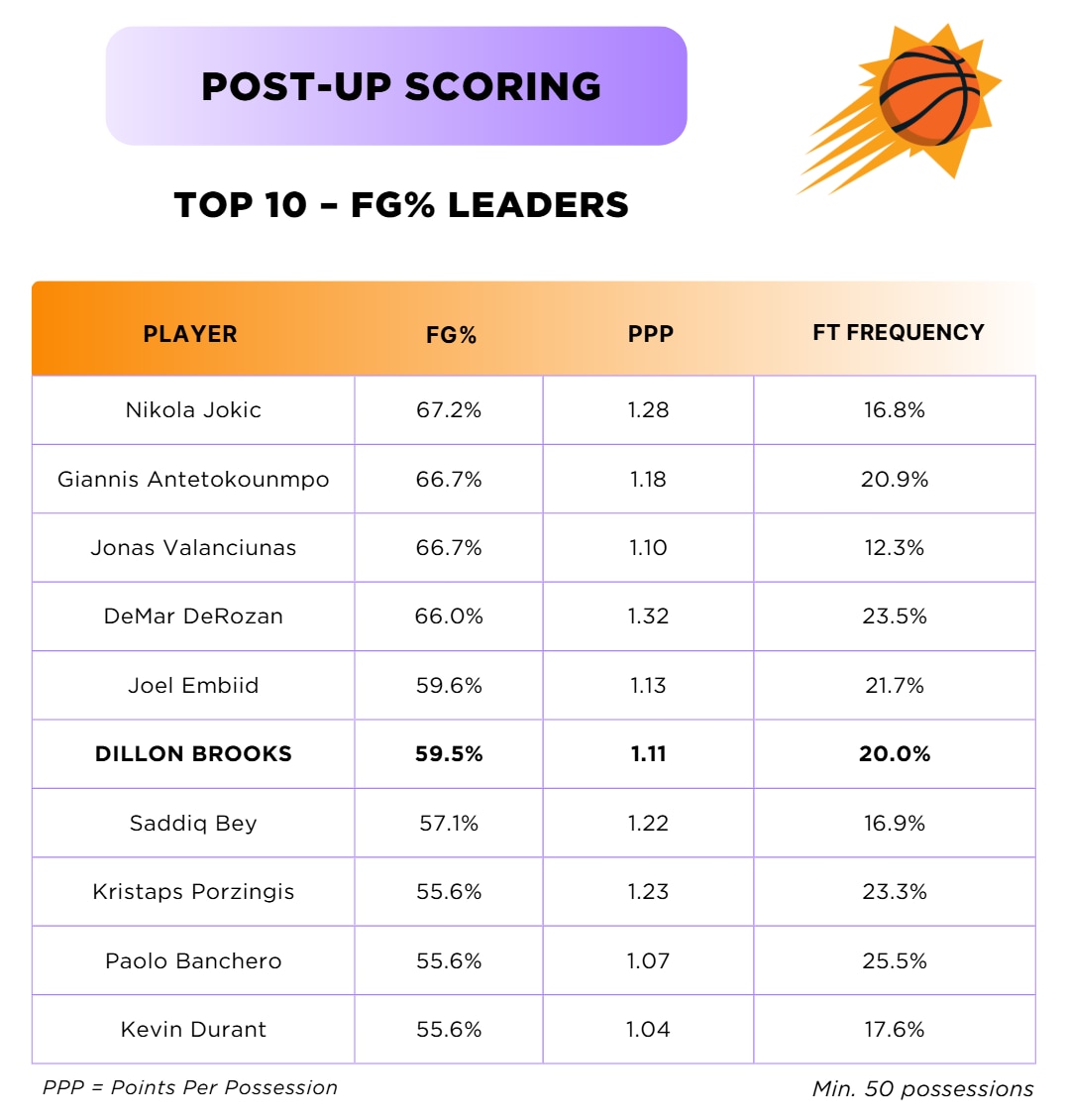
That’s two of the best players alive in Antetokounmpo and Nikola Jokic, mixed with hyper-efficient big men in Joel Embiid and Jonas Valanciunas, and mid-range maestro DeMar DeRozan.
This production is becoming the norm for Brooks as he’s enjoying his athletic prime. He’s about to turn 30 years old in two weeks, and this is usually the magical point of a player’s career where the strength and speed meet the veteran wisdom.
“I feel like I have an array of moves that I can use at my disposal,” Brooks says. “I worked on it all summer. It’s one of those [shots] that’s hard to guard. To add that to your game, it makes you a valuable piece on the offensive end.”
Against smaller defenders, it’s pretty much a wrap. The Suns have played roughly 111 minutes with Brooks technically as the small-ball power forward. On those possessions, they have dominated with a 131.4 offensive rating. That would be in the 99th percentile among all lineups this year.
Mark Williams already knows what’s coming when Brooks gets a mismatch down there. If there’s a mouse in the house, give him the ball.
“It’s wild,” Williams says. “I was just talking about it at practice. He had an ISO yesterday, it was literally him and the whole left side of the floor to work with. He opened up with a little hip-to-hip back down, shimmy, one-legged fade. He’s obviously been super efficient with them. I wasn’t too familiar, honestly.”
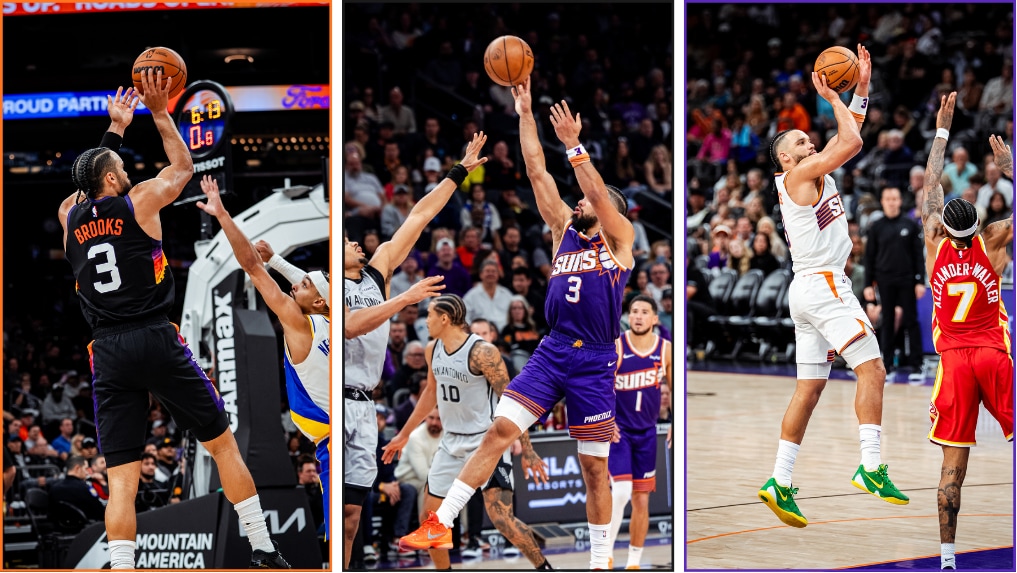
Now, shooting 52% on all shots within 8-16 feet this season and ranking 13th in isolation points per possession, Brooks has put the league on notice.
Nobody becomes this polished at one skill without many summers of obsession, trial-and-error, and understanding that it’s not going to come overnight.
“Give Dillon a ton of credit for the amount of work that he’s put in, to put himself in the position where he can score efficiently at multiple levels,” Ott said. “He’s been an advantage creator for us. And I’m not sure we anticipated that coming into the season. That’s a credit to the work he’s put in – I think it’s been across multiple years, obviously.”
The secret sauce to his offensive efficiency this season? Not rushing anything and staying observant while operating in the mid-range.
“My trainer always tells me to be patient and that’s the main thing,” he said. “Get the feel, know where the defense is, the weakside … and you always have a trusty, reliable shot you go to. For me, it’s just understanding the space between me and the defender, and then creating more space with a bump, fake, or pump-fake. Then, working on shooting over each shoulder so you’re not just limited to one move.”
Booker remembers the early days of competing against him in Memphis, before Brooks had refined his offensive game and become a major threat on the scouting report.
“But now, you can see the work,” Booker says. “And it’s brought the confidence with it. So it’s been a pleasure to watch him develop in a whole new situation and take advantage of it.”
Now, they’re sharing the floor and pushing each other every single day. In a loaded Western Conference, the addition of Brooks has revitalized the Suns, lifted the spirit of everyone in the locker room, and made them one of the NBA’s most competitive teams.