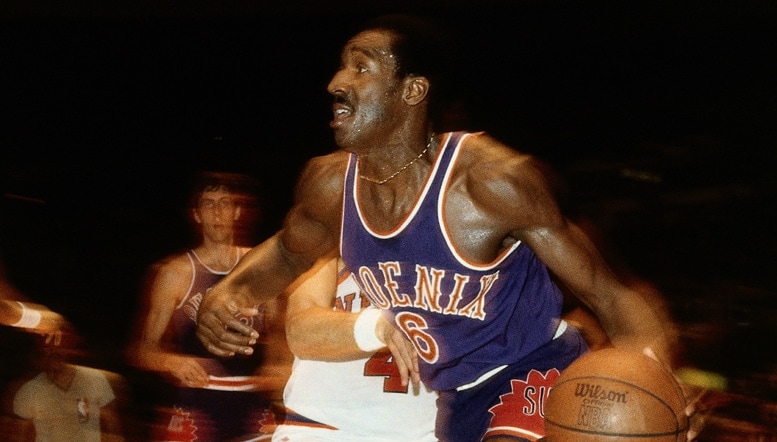
The Suns -- holders of the fourth-best winning percentage in NBA history -- have logged 19 seasons of at least 50 wins or more. That would still be true if you lopped off the first 10 years of the team's history.
Expansion and unfriendly division allignment played a big factor in the team's slow start to NBA relevance. When the Suns made their first-ever playoff appearance in 1970, they did so with just 39 wins under their belt. The following offseason, further league expansion resulted in the existing two divisions (East and West) be turned into four: Atlantic, Central, Mdiwest and Pacific.
Unfortunately for the Suns, "Pacific" was very literal back then, which meant they were slated in the Midwest Division along with contending Milwaukee (Lew Alcindor and Oscar Robertson) and Chicago (Bob Love, Jerry Sloan).
With only two playoff spots awarded to each division, Phoenix found out the hard way that 50 wins was a must. They finished outside the postseason in 1971 and 1972 despite winning as many or more games than other division winners, including the 70-71 Lakers and the 71-72 Baltimore Bullets.
Pheonix's quest for the playoffs and/or 50 wins continued past the Connie Hawkins era and through the Charlie Scott period. It wasn't until the summer of 1975 -- when the Suns drafted Alvan Adams fourth overall and traded Scott for Paul Westphal -- that the Suns turned the corner for good. A Cinderella run to the 1976 Finals put them on the NBA map and, after a brief step backward the following season, Phoenix had a solid core in place for a prolonged run at relevance.
The Suns narrowly missed out on the magic 50-win mark in 1977-78, falling short by just one game despite a Rookie of the Year campaign from North Carolina product Walter Davis (24.2 ppg, 6.0 rpg, 3.4 apg, 1.4 spg, 52.6 FG%).
Phoenix was on pace for 49 wins again by mid-January of 1979. That was when they pulled the trigger on a trade that would help fortify their biggest weakness: interior muscle. Gar Heard, one of the heroes of hte 1976 team, was fast declining into the twilight of his career. Adams, a high-post center who relied on passing and shooting, needed another enforcer alongside him in the frontcourt.
The Suns saw an opportunity to address that need in Leonard "Truck" Robinson. The 6-7 power forward had earned his first All-Star and All-NBA First Team honors the previous season, as well as the league rebounding title. Despite those accomplishments, Robinson had grown disenchanted with the inner workings at New Orleans and requested a trade. The no-trade clause in his contract essentially gave him his choice of destination.
Picking the team out in the desert, he told Sports Illustrated, was easy.
"Me and Walter Davis?" he said. "A great high-post center like Adams? A shooter like Westphal? A quarterback like [Don] Buse? I could have gone to New York or Philadelphia for lots more money, but I could not find a team more perfect for me than Phoenix."
Incredibly, the Suns did not have to part with any of their starters to acquire the talented Truck. Two reserves (Marty Byrnes and Ron Lee) and a pair of first-round picks were enough to give Phoenix the only starting lineup in the league that boasted five players with previous All-Star credentials.
That proved enough. Robinson averaged 16.0 points and 8.7 rebounds the rest of the season, helping Phoenix to a 24-15 finish that included win No. 50.
The Suns rode that momentum all the way to the Western Conference Finals, ultimately losing to Seattle in a heartbreaking fashion (they led the series 3-2 before losing Games 6 and 7 by a combined five points).
As for Truck, he continued to play the enforcer's role alongside Adams for another three seasons which another All-Star berth and two more 50-win seasons.