Here's the problem facing the Pacers, the problem that must be resolved if they are to hang on to their tenuous grip on a playoff seed:
How do you make a big lineup work against smaller teams that spread their offense and rain 3-pointers on your head until you're drenched in sweat? Not just the hot sweat that comes from chasing after 3-point shooters, but also the cold kind that results from anxiety.
The Pacers' 111-102 loss to Portland on Sunday gave them plenty of queasy feelings to take into their four-game road trip, which begins on Monday in Cleveland. Not just because of the result, which was bad enough, but more because of the trend it established. It's as simple as 1-2-3. Opponents are scoring in triplicate while the Pacers struggle to get two at a time.
Over the last three games, against New York, Charlotte and the Trail Blazers, the Pacers hit 10-of-48 3-pointers. Their opponents hit 38-of-78. That's a difference of 28 made shots which, multiplied by three, equals 84 extra points for the other team, which tends to be a formula for defeat.
"We're struggling against spread teams tremendously," said Paul George, who scored just 11 points on 4-of-15 shooting. "We've been beat every single time the same way. We let a team that we know is hot get hot from the 3-point line. They spread us out and they do what they want with us. I don't know what else to say about it."
He did, but we'll get to that later.
The box score for Sunday's game was unique, to say the least. The Pacers outscored Portland by one point in three of the quarters, but were outscored by 12 in the first and only won the fourth because the reserves controlled garbage time. They committed only nine turnovers, controlled the boards 52-45 and got to the foul line more often as well.
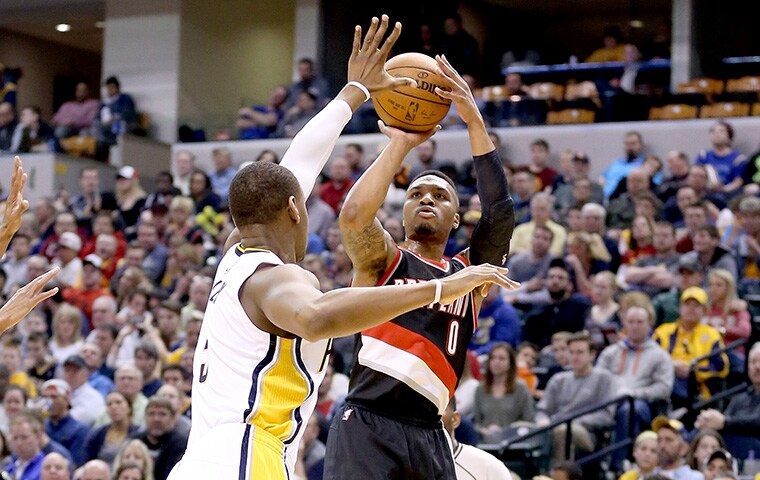
The Blazers' 33-point advantage from behind the 3-point line, however, was more than enough to make up for any deficiencies. They hit 14-of-24 3-pointers while the Pacers hit just 3-of-14. Damian Lillard led the way with 33 – 20 in the first quarter – further establishing himself as the next-best thing to Stephen Curry. Lillard scored 51 points against Curry and Golden State on Feb. 19, one of the victories in its current run of eight over the past nine games. He's averaging 25.4 points for the season.
It wasn't just Lillard, though, who reaped the rewards of Portland's fluid offense. Gerald Henderson came off the bench to score 19 points, hitting 8-of-9 shots, and Meyers Leonard – 7-foot-1 Meyers Leonard at that – had 17, hitting 4-of-5 3-pointers.
Leonard, who was playing in front of about 200 fans of the University of Illinois, where he played collegiately, scored 11 consecutive points to propel the Blazers' lead from seven points to 16 early in the final period. He hit a 3-pointer at the third-quarter buzzer, then another on their first possession of the fourth, then a driving bank shot and finally another 3-pointer that forced Pacers coach Frank Vogel to call a timeout and caused a smattering of fans at Bankers Life Fieldhouse to boo.
"We've got a bunch of unselfish players, we are trusting the next guy, we are playing hard and trusting each other," said Leonard, who had taken 197 3-pointers entering the game and hit 35.5 percent of them. "This is a really fun team to play for."
There was no fun to be found on the Pacers' sideline or in the locker room. With a flight to Cleveland waiting for them at the airport, most of the players had cleared out before most of the media members entered after talking with Vogel. Monta Ellis and George were left to explain two straight homecourt losses, which followed a promising stretch in which they won three of four, with the only loss coming in overtime in Miami.
They shared a common theme.
"They came out and did exactly what we expected them to do," said Ellis, who led the Pacers with 18 points, but hit just 6-of-17 shots. "We just needed more energy."
George was more blunt, speaking quietly with a cluster of media members for a couple of minutes before all but dropping the mic.
"We don't have no toughness," he said. "There's no toughness. You look at playoff teams one through eight, that's one thing every team has in common. That's what we've got to find."
How do you get it 59 games into the season?
"You build habits toward it," he said. "I don't know where to find it right now. We've got to look within one another. Each guy has to pull it out of the next person. We're all in it together. The teams I've been on, that's what we pride ourselves on. Making a stand individually and everybody else being accountable."
The Pacers were once one of the NBA's best at defending the 3-point shot, advancing as high as third. They had dropped to eighth by the time Sunday's game tipped off, and were lower by the end of the day. That's Vogel's dilemma. The smaller starting lineup, which defended the 3-point line well, struggled against the bigger lineups because it didn't rebound well enough and was inconsistent with its perimeter shooting. The current starting lineup, which includes rookie Myles Turner, rebounds well and usually scores sufficiently, but struggles to defend quicker teams on the perimeter.
Portland, for example. Charlotte, too. Even lowly New York outscored the Pacers by 30 points from the 3-point line before losing by three last Wednesday.
How do they correct that?
"Just locking in," Turner said. "We have to lock into our assignments, hold each other accountable."
Vogel seems committed to sticking with the current lineup. He's experimented plenty this season, and it's getting late in the season to try another. Besides, this one has been his best statistically, and seems to offer the best hope for a playoff run.
Besides, C.J. Miles, a starter in the small lineup, is out with a strained calf muscle. He shouldn't be out much longer, but probably won't play in Cleveland.
"I still feel like we're gong to finish strong," Vogel said. "We didn't play well the last two games, but I believe in the starting lineup we have. I think when we get our bench healthy and stabilized, they're going to be pretty good as well. I think we'll be all right."
So does George. The unity in the locker room remains intact, he said. It's a matter of finding chemistry on the court.
"We have a lot of basketball left in the season," he said. "This is not where we need to be playing our best basketball. It would be nice to be building habits going into when we need to be playing our best basketball. We just have to do a better job from top to bottom. Tune in and become who we are."
Have a question for Mark? Want it to be on Pacers.com? Email him at askmontieth@gmail.com and you could be featured in his next mailbag.
Note: The contents of this page have not been reviewed or endorsed by the Indiana Pacers. All opinions expressed by Mark Montieth are solely his own and do not reflect the opinions of the Indiana Pacers, their partners, or sponsors.